Angels

Saint Michael: Our Protector and Helper on the Way to God

“At that time Michael, the great prince, the protector of your people, shall rise” (Daniel 12:1)

On a rocky island off the coast of Normandy in France, a huge Benedictine monastery rises spectacularly into the air.  Although receding tides leave it connected to the mainland, the water rushes back in at great speeds as the tide turns.  These treacherous currents and the quicksands in the area have challenged pilgrims for centuries — pilgrims on their way to Saint Michael’s greatest shrine: Mont Saint-Michael.  Around the year 708, Bishop Aubert of the diocese of Avranches reportedly had a vision of Saint Michael.  The angel asked the bishop to build a church in his honor on the rocky island in the Atlantic.  Aubert built the shrine, which in 966 became a Benedictine monastery.  Devotion to Saint Michael flourished there and drew pilgrims from all over Europe.  During the French Revolution the shrine was converted to a prison; then, in 1874, it became a public monument.  In 1922, however, the French government allowed it to be used as a place of worship again.

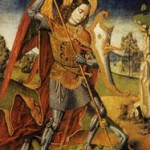
The rugged terrain of Mont Saint-Michael is an appropriate setting for a tough angel often invoked for help in the struggles of life.  Saint Michael is the best-known angel, and devotion to him has flourished through the centuries.  Many parish churches claim him as their patron.  Michael is also known as one of the saints who spoke to Saint Joan of Arc to encourage her in her unique mission from God.  But in a particular way, Michael helps us in the spiritual battle against temptation and sin.  This derives many from a text in the Book of Revelation:

“And war broke out in heaven; Michael and his angels fought against the dragon.  The dragon and his angels fought back, but they were defeated, and there was no longer any place for them in heaven.  The great dragon was thrown down, that ancient serpent, who is called the devil and Satan, the deceiver of the whole world — he was thrown down to the earth, and his angels were thrown down with him. (Revelation 12:9)

This text indicates that in some way Satan rebelled against God at the dawn of time before human life on earth existed.  Christian tradition has found in this text a basis for Michael’s key role in the battle against evil and Satan, a spiritual battle.  Because Scripture presents Michael as the protector of God’s People, he is seen as the adversary of Satan.

The Bible also refers to the Archangel Michael in a few other passages that deal with the end times.  These Scripture passages form the basis for devotion to the Archangel Michael.  The Book of Daniel states: “At that time Michael, the great prince, the protector of your people, shall rise” (Daniel 12:1; see also 10:13).  The Letter of Jude also refers to Michael contending with the devil (v. 9).  Apocalyptic writing is difficult to interpret and need not to be taken literally.  However, it indicates that Michael has a special role in protecting us from evil and dangers, especially spiritual dangers.  In speaking of the fall of the angels, the Catechism of the Catholic Church states: “We find a reflection of that rebellion in the tempter’s words to our first parents: ‘You will be like God’” (no. 392).  Michael, instead, chose to worship and adore God alone.  The very name “Michael” means “Who is like God?”


Three Familiar Angels: Michael, Raphael, Gabriel

Interest in angels crops up in unexpected places.  Not long ago I was in a store and a man came up to me and asked, “What angels are named in the Bible?” Although the Bible mentions angels often it names only three of them: Michael, Gabriel and Raphael.  After that incident I started to wonder why only those three angels are named  Biblical names are important because they express something about the person.  They also often say something about the special work God calls them to.  As I pondered this, an idea came to mind that might offer some light about why three and only three angels are named in the Bible.

This idea flows from what can be called “Way, Truth and Life” spirituality.  This is based on what Jesus says about himself at the Last Supper: “I am the way, and the truth, and the life.  No one comes to the father except though me” (John 14:6).  The founder of the Daughters of Saint Paul and the whole Pauline Family, Blessed James Alberione, made this idea the cornerstone of his spirituality.  Much could be said about it. But to condense it a bit, Jesus’ definition of himself as Way, Truth and Life concisely expresses how he makes us holy.  Holiness involves the complete person — mind, will and heart.  Jesus himself is the Truth that enlightens our mind; he is the Way we must follow; and he is the Life who raises us to life of grace with him.

The aspect of Truth speaks especially to the human quest for meaning.  What is the purpose of life? Why am I here and where am I headed? These are the most profound questions that human beings can ask, and people have always pondered them.  In the Gospel we find Jesus, the “true light, which enlightens everyone” (John 1:9).  As Pope John Paul II said so often, Jesus is the one who reveals us to ourselves.  In Jesus the Truth, our minds find the fullness of truth.

The aspect of the Way brings us into the area of how to live a fully human life.  Knowing the truth is vital but not enough.  Unless it is translated into action, it could remain sterile, like a bookshelf crammed with unread books.  As the Way, Jesus shows us how to live a fully human life.  Ultimately, this is the way of love.  The secret of finding happiness is to pour ourselves out in a loving gift of self.  This may lead to suffering, as Jesus himself experienced as he hung dying on the cross.  But resurrection follows.  In Jesus the Way, our wills find the strength of virtue.

The aspect of Life leads us to the fullness of grace and the spiritual life.  Through prayer, te sacraments, and the Word of God, Jesus nourishes us and fills us more and more with his divine life.  As this life takes root in our souls and grows, our whole lives are transformed into a hymm of praise to God.  In Jesus the Life, our hearts find the fullness of grace and love.

So how is all this related to the angels? The three angels — Michael, Gabriel and Raphael — can be seen as part of the Way, Truth and Life spirituality.  Michael, who stood for God and overcame the devil and his angels, leads us along the way of virtue.  Gabriel announced the Good News, the truth of the gospel.  And Raphael, the angel who brought healing to the family of Tobit, can be seen as representing the fullness of life that God desires for us.  So we can find in these three angels a good summary of the Christian life.  Perhaps the names of only three angels were revealed because the three of them together express in some way that Jesus meant by the Way, the Truth, and the Life.